The arrival of dozens of new ships equipped with more complex systems and smaller crews creates a significant maintenance challenge for the Royal Netherlands Navy. During the WCM Summer School 2026, participants will examine how the Ministry of Defence can keep the next generation of naval ships fully operational while having fewer technical personnel on board. “It is precisely the combination of technology, data, and organization that makes this issue so interesting,” says Tiedo Tinga of the Royal Netherlands Defence Academy.
The case for the WCM Summer School 2026 is provided by the Maritime Systems department of COMMIT in Utrecht and the maintenance organization DMI in Den Helder. A key component of the case is the desired transition from traditional periodic maintenance to condition-based and predictive maintenance.
Tinga acknowledges that this topic is not new. “We have been talking about predictive maintenance for years. But now, urgency is emerging. The Navy is receiving many new ships, which provides an opportunity to design maintainability differently from the outset. At the same time, crews are getting smaller, and it is becoming increasingly difficult to find sufficient technical personnel.”
New Generation of Ships
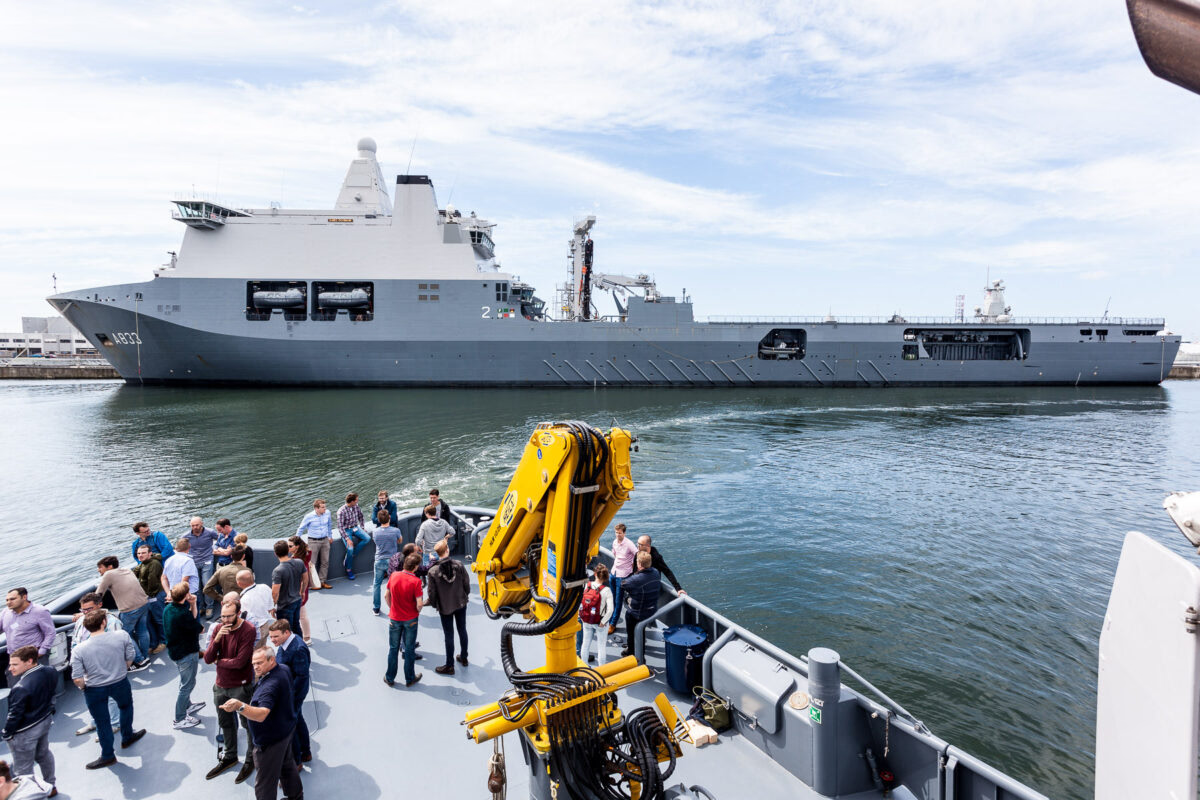
The fleet’s modernization is extensive. In the coming years, several new frigates, submarines, and support ships will be built and commissioned. This new generation of naval vessels contains far more sensors, software, and integrated systems than before. “Ships are becoming increasingly complex,” says Wieger Tiddens of the Royal Netherlands Navy. “In the past, you had many technical specialists on board who could solve problems immediately. In the future, ships will sail with smaller crews and fewer technicians. This means we must manage maintenance more intelligently and ensure that things break down less unexpectedly.”
‘It’s about discovering new directions together’
Data-Driven Maintenance Concepts
This is why Defense has been working on data-driven maintenance concepts for several years. Sensors aboard the ships collect data regarding the condition of equipment and systems. Ultimately, this should lead to better predictions of malfunctions and maintenance needs. “But a sensor by itself does nothing,” says Tiddens. “The challenge lies in the entire chain: how do you collect relevant data, how do you get it safely from ship to shore, how do you analyze that data, and how do you ensure the organization actually takes action based on those results?”
Much More Than a Technical Issue
It is this broad scope that makes the case so interesting for the WCM Summer School. According to the initiators, it is explicitly not just about technology. “Switching from planned maintenance to condition-based maintenance also changes the organization,” says Tinga. “The rhythm of the maintenance workload changes, meaning you must be able to plan more flexibly. Additionally, questions arise regarding collaboration with suppliers, data ownership, cybersecurity, and trust in algorithms.”
Algorithm vs. Intuition
Because even if an algorithm accurately predicts when a system needs maintenance, it does not automatically mean that humans will trust that prediction. “That human aspect is incredibly important,” Tinga continues. “An experienced technician might think: ‘The algorithm says this, but my gut feeling says something else.’ How do you deal with that? These are just as interesting questions as the technology itself.”
A Different World
Furthermore, the Navy operates in an environment that differs significantly from the commercial world. Naval ships are built in relatively small series, operate worldwide under wildly varying conditions, and contain sensitive systems and data. Moreover, the Navy has no profit motive, yet it is essential that systems do not fail unexpectedly during missions. Consequently, standard off-the-shelf market solutions are not always applicable. Tinga notes: “That makes smart maintenance in a maritime defense environment extra challenging.”
A Fresh Perspective from the Outside
The Navy explicitly views the Summer School as an opportunity to gain new insights from young professionals, PhD candidates, and students from diverse backgrounds. “We hope that participants won’t be hindered by all the assumptions and limitations we have built up over the years,” says Tiddens. “We naturally look at things through the lens of our own organization and experience. It is incredibly valuable when someone from the outside asks: ‘Why don’t you actually do it in a completely different way?'”
More Collaboration
According to him, that fresh perspective is especially important because Defense’s maintenance organization is currently in the middle of a transformation process. Defense is growing, the fleet is changing, and at the same time, the Navy wants to collaborate more intensively with educational institutions and industrial partners. “In the past, Defense handled much more internally,” says Tiddens. “Now we are looking more closely at collaboration with the market. How can you smartly utilize the knowledge and capacity of partners? What role can suppliers play in predictive maintenance? These are questions we are seriously addressing.”
Learning from Each Other
During the WCM Summer School, participants attend lectures and workshops led by professors and experts from various Dutch universities and research institutions. Topics range from predictive maintenance and data analysis to logistics, life-cycle costing, reliability engineering, and collaboration in complex ecosystems. Additionally, participants work in teams on the Navy’s practical case. A leadership training module is also part of the program. Furthermore, participants receive an exclusive behind-the-scenes look at the Royal Netherlands Navy’s maintenance organization in Den Helder. “Just that tour of the shipyard is worth the effort to participate,” Tiddens says with a laugh. “You get to go to places where almost no one normally goes.”
Collaborating and Sharing Knowledge
However, according to Tinga, the real added value of participation lies primarily in collaborating and sharing knowledge between participants from different sectors. “In every edition of the WCM Summer School, you notice that people are facing similar problems,” he says. “By working on a case together, you discover connections and solutions that you might never have found on your own. That is what makes the Summer School so valuable.”
The case is intentionally framed quite broadly. The organization does not expect fully developed end-solutions, but rather new perspectives and creative ideas. “If participants come up with angles that we haven’t thought of yet, then the Summer School has already succeeded for us,” Tinga concludes. “It’s not about someone finding the answer in one week. It’s about discovering new directions together.”
The WCM Summer School 2026 will take place from August 24 to 28 in Den Helder. Visit the WCM Summer School website for more information and registration.